Airship Dragoon Version 1.1 has been released. The patch weighs in at a mere 26.6Mb. All new purchases will automatically get the latest version.
Fixes an issue with veteran information not saving correctly during campaign modes.
Various tweaks to reduce overhead and improve performance but will probably only be noticeable on low spec systems.
If you've bought it direct and don't want to redownload the whole thing, install the update.
The update can be found here under the "Updates" section. http://www.yorkshirerifles.com/webpages/store.html
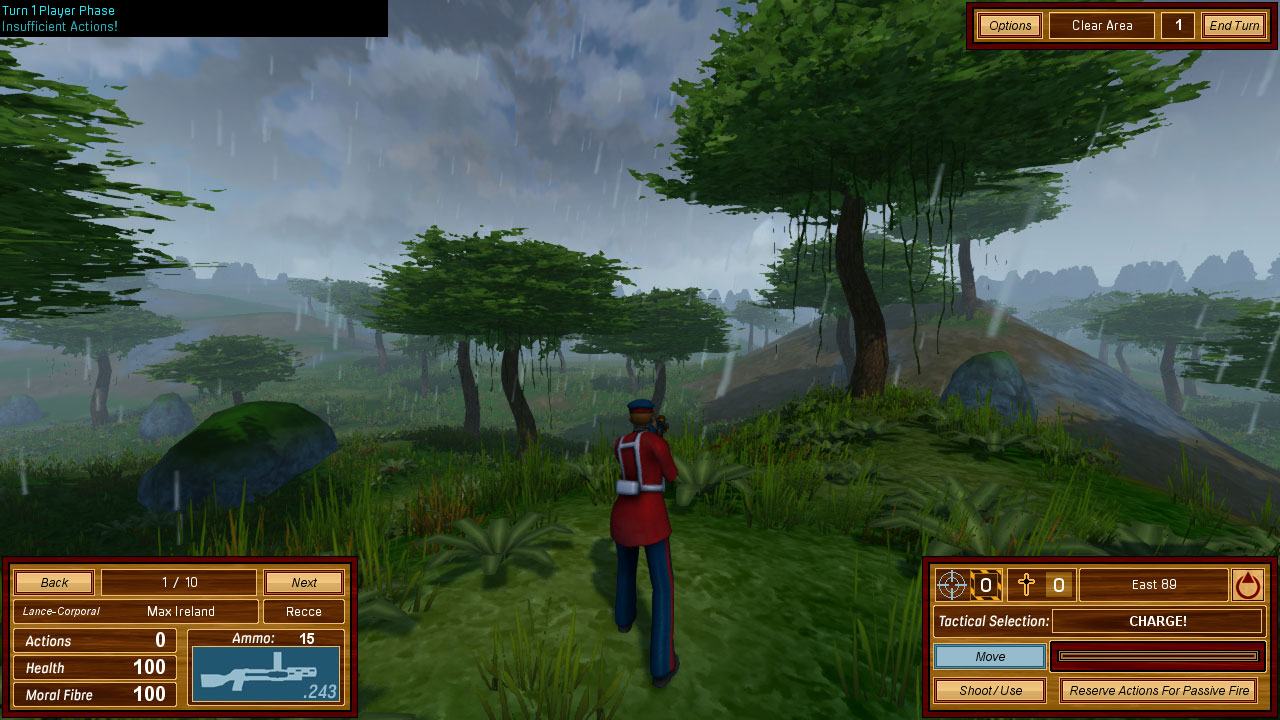
Zulu Nation Uses Artillery Barrage ...
IT'S SUPER EFFECTIVE!
Vote For AIRSHIP DRAGOON on STEAM GREENLIGHT!
It would be appreciated ... thanks.
Virtualizing The Virtual!? Is that a double negative? And if it is, does that mean that the virtual is now physical? If so, I for one welcome our new Steampunk Turn Based Tactical Artificial Intelligence Overlords ...
So, there I was, playing away, testing my game. It was night, poor visibility ... also probably in real life too ...
I was defending a flag from pirate assault ... back in the game now, not in real life ... when I realized that sometimes it takes a while for the Ai to get into the attack, especially when visible distance on the battlefield is very low. I had got my troops into my chosen defensive positions early on, and now kept clicking for the Ai to take it's turn and advance against my forces. And it was taking a while ...
Which is when I hit upon the idea of virtualizing the Ai's move. First check that they can't be seen, then make simulate how far along their path their current tactic can take them distance-wise, make sure that they'er not going to be spotted by the player's forces, and dump them at the end of their phase, decreasing their Action Points as if their turn had been taken normally. For the player, no more interminable waiting whilst the Ai to complete something that they can't see. 3+ minutes for the Ai turn could become 45 seconds.
And if the Ai could be spotted during their virtual movement, then play their turn as normal, have the player's trooper spot them, and let all hell break loose as normal.
Needless to say ... it turned out to be considerably more of a pain in the backside to get it to work correctly. First up my test function - 5 whole lines - worked lovely ... then when I rolled it into the full Ai thinking process - 10000 lines - I had to invert the values.
Then they kept falling through the terrain and other objects - make a check for that - then they all try and jump on each other - check for that - then they fall off the end of their path somehow - check for that - then they have the falling through terrain issue again - recheck post virtualized move for that. But finally it all works. The key of course was to slap the camera on the Ai so I could see what was happening when it all went wrong.
And so here's a little video of something that will never be shown in general gameplay - the Ai moving in dev mode.
Also I finally finished off the last of my character art - so here's a video of all of the different factions in various conditions.
Character types:
Unarmoured - with hat
Light Armour - helmet
Stealth Armour - helmet and camouflage
Heavy Armour - tin man with Regime flag facings (not all flags finished at time of video)
Followed by repeats of the various regimes in various environments with various weathers.
You might want to up the quality level - no idea why it's defaulted to 360p when it's in 720HD ...
I finally also finished the flags for all of the regimes - though admittedly after that video had been taken. I didn't want the flags to be particularly historical, as that kind of takes the fun out of it being Steampunk.
This is what the Single Battle Mode options screen looks like now:
From the left:
That's a stylized Imperial Engle on the Austro-Hungarian Empire
Union jack ensign and crown for the British Royalists
Traditional Chinese (Cantonese) word for Dragon for Chinese Dynasty - I came up with this after many failed attempts to make a stylized dragon design that I liked ... then thought that using the script for the word might be nice. Colours taken from the Qing Dynasty of the Steampunk peroid. They did have a dragon picture on their flag but I didn't like it.
Soviet Constructivist Colour Scheme for the People's Collective. Always knew that degree in art history would come in useful eventually ...
Slight change on the 1877 version of the Stars and Stripes by making the twin circles of stars into solid hoops for the US Replubic faction.
And finally, because of alphebetical order the Zulu Nation.
I sorted some really annoying issue with the Ai not always updating their aim aniation - probably self inflicted due to the manner in which I've changed spawning and mounting - and also made a rather spiffing icon for my game.
This being a MUCH larger version of said icon ... obviously.
I'm beginning to hate that word ... We'll soon head to
thesaurus.com to find a new one with the exact same meaning. Anhow,
things which had been redone ... got redone ... for the umpteenth time
...
Yo Dawg! I heard you liked to redux, so we put a redux in your redux!
FFS ...
Anyhow, following on from a previously posted blog in Septemger 2012 entitled "Make Simple Character Model Quickly ... 40 Days Later ..." where I struggled with character limb deformations ... I have ... gone back and started it again from scratch.
And after 16 days, I can live with it ... which ... admittedly is what I said about the last effort ... but then I couldn't. Anyhow, it now deforms nicely, animates much better and ... probably looks exactly the same to the casual observer. But hey, it offended me ... and now it doesn't.
So with a fully, clean, base character mesh I can now get on with making all of the other troop types. I've also got rid of a few more of the engine's stock assets which I was using, making my own backpack ... which turned out to be an ordeal in itself for some reason ... an aidkit model and replacing the decal for moving to with a big black and amber X motif which spins.
I've made various tweaks and improvements to my scripts, and am down to just one post-it note of bugs, tweaks and balancing on the Main Campaign.
I've also redone the 4 jungle levels which I had designed. After receiving feedback that they weren't very jungly I've bent the tree trunks, added a skirt of transparent hanging vines in 2D, increased the number of said trees in the levels and created a new broad leaf plant for the groundcover, which helps to make the scenes much more crowded looking. In other words, more jungly.
I've also created 4 urban environment maps. This brings the total levels to the final tally of 20. There's a video below showing one of the maps - which just happens to be the one without any avenues of trees. I always try and give each level it's own theme such as highground, valley, rolling hills, etc, and this one is tight corners. The urban maps feature buildings - which whilst they cannot be entered directly - have ramps and bridges and crossovers. I was going for a sort of grand European architecture vibe.
So next up, an Ale Festival on Thursday! And after that, modeling the troops for the remaining 6 factions, sorting out the remaining issues with the Main Campaign, doing a whole load of finalized modeling and ... er ... stuff.
Finally I have managed to get round to creating some new maps for the different environments and terrains. Up to now I've been reusing the same map over and over again. Now I have one map for each of the available environments - save for urban which I'm still working on the models for. I am planning on each environment type to have a few different maps, and have managed to come up with a workflow process to create these without too much hassel ... which makes a change from my usual "make it up in a completely adhoc manner" which permeates my existence.
I've reused or modified base textures where applicable in an attempt to keep everything looking uniformed and together. I use the same rock texture throughout all environments so that the player always knows which part of the terrain is an obstacle that cannot be walked up.
Whilst making various new models I also finally got round to replacing the rather awful blue/black hatched deployment areas with some brass poles with flashing amber lights on them. It all looks much better and a lot more part of the steampunk aesthetic.
For the umpteenth time I have once again reworked the aesthetic of all of my GUIs, this time giving them a wood grain look which I think looks much better than the rough, patchy look which they previously had.
I also added two new buttons to equipment selection on the deployment screens. These allow for filling up a trooper with ammunition to the maximum weight or money, and also copying the current troop's equipment to all other unequipped troops of the same class, weight restrictions applying. This all helps making loadout a lot faster and easier for the player.
I'm still not best pleased with the mesh deformation of my - currently singular - player character model and intend to fully rework this. Hopefully it'll end up looking a lot better and I will then be able to get on with making troop models for the Pirates, US, Austro-Hungarians, Chinese, Zulus and Anarcho-Commies, as well as finalise my design for the heavy armour models.
I've also done extensive playtesting of the Main Campaign - the one with the dirigibles in it - and found it to be a bit too easy. I rebalanced the way the Ai regimes work ... and then it became too hard ... fuuuu-. After a bit more balancing it needs a good retest to make sure I haven't made it too easy again ...
I've been working off the MIT console refrator development branch and apart from a few issues with the development branch itself, I think the console refraction is fine. Info on that here.
Anyhow, here's some vidya of the new environmental maps, each one played in the most likely weather pertaining to that environment. Mountains are cold and cloudy, Arid is fine and clear and hot, Jungle is wet, humid and stormy.
First up, after years of spamming the site with jokes and the occaissional helpful post, I joined the hallowed ranks of the Titans, striding the earth with inflated ego and a pair of socks pushed down the front of their pants ...
... that's the GarageGames Associate program to normal folks.
Steve joins the other Associates for hor d'oeuvres at their Fortress of Perpetual GrimDark
So, on to drawcalls ... and ... oh wait ...
That's better ...
So, back to them drawcalls. I've a vague recollection of mentioning the damn things before in about a gazzillion blogs, but I'm always on the lookout for screwing every last bit of performance out of the engine. I'd been looking at my last demo and wondering if I could amalgamate more of the textures on the buildings. There's a lot of tiling going on with them ... so I decided to try a few experiments in reducing the sizes and adding more sections on to a single image. There was obviously going to be a fair bit of a loss in detail quality, especially close up - but as my work has obviously never been about heavy psuedo-realism, I figured I'd be able to live with it.
Original prop building at the top (5x 512 tileable textures), new single 1024 texture at the bottom.
And live with it I can. I still need up to 4 meshes for an enterable building (exterior, lightmapped interior, lightmapped props, and transparent windows). But for "prop" buildings I managed to get away with a single 1024 texture. I wasn't always able to get a mesh into a single drawcall, occaissionally requiring more, but over all my worst saving of drawcalls was 50% and my best 80% for enterable, lightmapped buildings. All my prop buildings had their drawcalls reduced to 1 from around 5. I also decided to cut out a lower LOD and suffer a few more polys at mid-range now that there's less drawcalls.
I'd also tried the same thing with my many road sections - but visually they really seemed to suffer in a much more noticeable way. So I decided to make a "supermesh" roadsystem which promptly truncated because I'd turned all the warnings of in Blender ...
So after splitting the new supermesh up a bit I'd added 130K polys to the scene for the loss of a poxy 31 drawcalls and no performance improvement with some dodgy shadowing along the now more open meshes ... which wasn't really win ... and promptly reversed the roads to how they were.
After seeing Brian Mayberry have lots of fun with glowsticks - I decided on more function creep and created flares for my player. I'd wanted to avoid a torch (US: flashlight) as it's a bit obvious and always availalbe in a HL2 type manner --- nice flashlight resource though CSMP. The flares are actually quite useful as some of my levels are intending to be "dark" - in fact Level 1 corridor crawl is fairly dark - and I've hidden pickups in various dark corners.
Which actually brings me to Level 1 of my Campaign - which is about done, just a bit more drawing to do for plot devices., but all the action is scripted and tested and tweaked and retested. There's 2 routes through it, it's got a nice ebb-and-flow of action, from scary melee based monsters creeping about in the dark, to intense, open firefights and back again.
My single player narrative campaign mode did throw up a few new issues. I created a checkpoint system so that a deceased player didn't have to restart at the beginning ... which would be fairly annoying as it takes a good 30 minutes to get through the level regardless of which path you take, and you can crossover between them in a few parts. My checkpoint respawning threw up another problem of finite pickups. Yes the dead Ai drop ammo, grenades, etc - but if you're already bulletless then it's kinda hard to get at a whopping great big alien tooled up to the nines with an automatic weapon from 100 units away when you have a melee ranged cricket bat. So I had all the "static" pickups respawn with the player, via a new permanent field that I added to the code (I'm still slowly chipping away at the cpp before getting around to making a full frontal assault on programming at a later date -- I did try to create a custom "thin" version of shapebase but it didn't go well).
All in all it works quite nicely, the extra ammo helps if the player is finding it tough. The player respawns into the continuing game rather than a reloaded one, so if you've killed half the bad guys at a position before being sent beyond the mortal coil yourself, you only have the remainder to get past. I've still to sort out a full "external" save system for campaign progress or restarting a game half way through.
And so on to cutscenes - or really player controllable in-game comics. There's next/back buttons so that the player can flick through triggered plot scene. These are mostly for story, my jokes, and occaisional hints/tips. The story boards and in-game comics are there to "complement" the gameplay - but there's a big old "Skip" button if the player would rather just get back to the action without flicking through them all.
Never let it be said that I ain't a sucker for dry wit ...
In other news, I added a visual indicator of the number of player lives remaining in the "random battle" mode (3 lives for each area - previously you had to read the info to know this and then keep count), and will also add this to a selectable "challenge" mode for the campaign levels. Eventually I'll figure out some sort of scoring system for all modes as well - not particularly important in campaign, but it takes on more significance in "random battles" and any possible, future co-op mode.
Anyhoo - vidya! Here's the comicbook and flares in action ...
And here's an older one without them which features a play through of the first 5 minutes of one of the routes through the level.
I've a few more things to sort out yet, a bit of GUI refaffing for various menus, and finishing off level 1, plus creating a randomized battle mode for that map. And then I'll release a new demo, probably next blog - which will be done when it's ready.
With construction of a vaguely working alpha demo in progress, I was hammering away at the splash screen license obligations ... a glance to irc and wtf everybody's just got sacked that worked on the engine tech I use ...
So, it's been user interface work recently, and additional gametype ... err ... types.
I'd been quite chuffed with my implementation of a randomized gametype, and had expanded on the initial idea. There were 5 open areas of a 2km level, the player was randomly equipped and initially randomly spawned at one area and each area had to be cleared in any order the player fancied. Random numbers of Enemy Ai were randomly spread through each area, and randomly armed with either short or long range weapons depending on what sort of view they had. Hiding inside a house = short range, view from a window or rooftop = long range.
I figured I could throw in a few more random ideas to increase gameplay, and so came up with strongpoints and counterattacks on top of clearance ... which happen ... randomly. Thus each area could be a standard clearance operation where the player had to hunt down each Enemy spread throughout the area, but now it could also be an assault against a randomly chosen building crowded with hostile Ai, or the enemy Ai would come looking for trouble when they heard allies shooting ... but only halfway from their defensive position to player spawn area to prevent spawnkills. Regardless of random tactic type, all short-range weaponed Ai always counterattacked over a very short distance to prevent themselves being picked off at range, that way long-ranged Ai would stay put to provide supporting fire whilst short-ranged would be mobile around the goal node.
First attempt at Ai pathfinding in level
And I'd managed to fit in my "anti last man standing" idea, where the allied Ai swarm over the location of the last remaining enemy, thus preventing those frustrating "can't find the last bad guy to finish the level" type issues which can occur with such things.
I gave the player 3 respawns per area, and had dead Ai drop either ammunition, grenades or a small health pack. Each area took me around 20 minutes to play through, and taking down all 5 areas of the map could take 2 hours. So I made a "fast gametype".
Level Selection and Fast Game Mode
Fast gametype was a random strongpoint attack in a single area, with a slightly more beefed up number of random enemies to guarentee plenty of action. This made me think of a few variations for additional gametypes ... but ... y'know ... one thing at a time.
As ever, I found a gazzilion issues with everything I did, great swathes of script wrote at 5am that were never going to function properly in the cold light of day, and various other bugs that got stomped on and features that got relentlessly tweaked.
All this new stuff needed a user interface. Not just for mission selection, but also the type of instructions and info that you'd expect, such as what the controls are and what the differences between the various weapons are.
First Attempt at user interface that vaguely makes sense
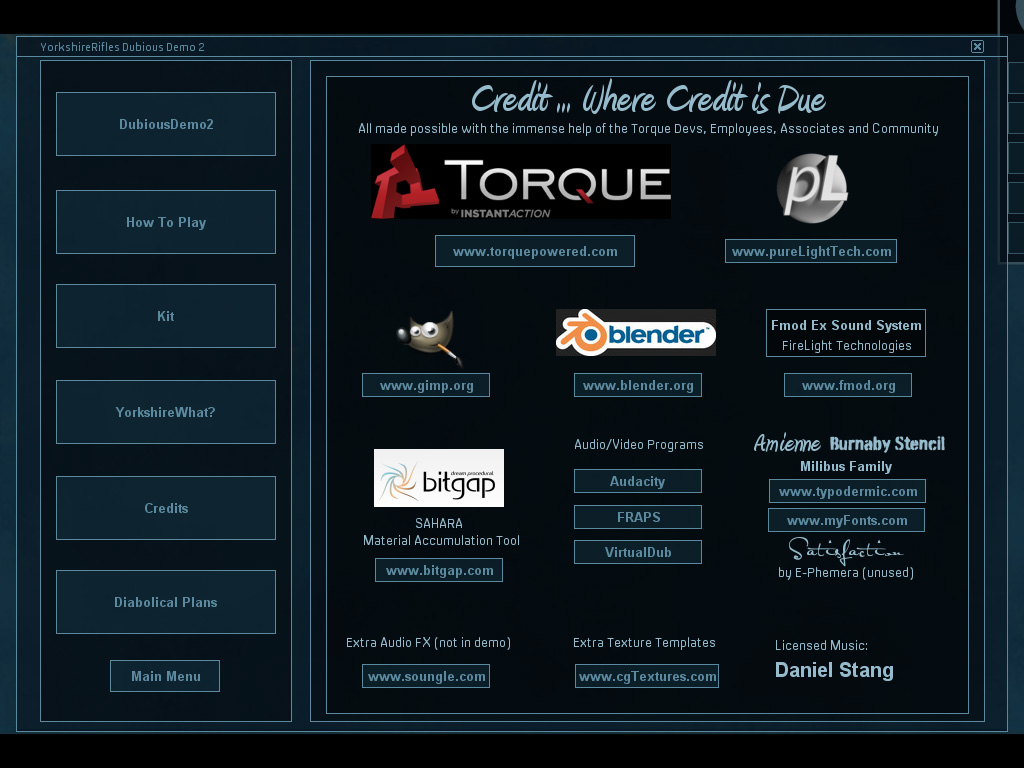
I also thought that it might be a good idea to explain what the hell the whole thing is ... plus I then had to look through all of my stuff to see what I'd used. Now, I have attempted to do as much as I can almost all of the audio is my own - but I couldn't get a good fire/burning loop, but everything else is self done. All of the models are hamfistedly made, rigged, textured, animated by myself. I used various self shot photos for base texture templates and tiled them myself ... and then got the rest of the templates from on-line. Fonts and music weren't even worth my attempting and so were straight off licensed from the start. I haven't even looked at Fmod Ex yet, having just thrown in the audio dll. And that's all this stuff takes so much time.
Credit Page attempt 2
And then there were some annoying issues. My pathfinding is based on a waypoint resource, though it hasn't scaled well to such a large and open environment. I've got a level with a lot of changes in height and direction and the sheer number of waypoint style objects for the Ai to navigate around the whole thing has eaten 25 percent of my performance - which is annoying ...
But currently ... that's how my alpha demo will be going out. Afterwards I'll have to take a look at nodegrids and maybe other solutions as a replacement.
Also I need to do a bit of 2D artwork to "tart" it up a bit, and 2 of my buildings are still placeholders. And there's some functions hacking I think I might try as a performance test ...
But all in all, we're well on our way ... and ... allegedly ... I should be able to crank out a rough but playable demo full of issues by the end of November. Which is 12 days away ... awww hell ...
Environment Completed ... Sort of - oh wait ... haven't I already used that blog title? And actually it's the same level! But things have slightly changed ... if "slightly" really meant "quite a jolly lot". 2km of open game world, with 838 random AI spawnpoints - count 'em.
Click the pics to view them full size if you're squinting.
Right-ho, so what have we got? One 2km map with full drawdistance. 88 buildings, 34 of which are fully open, furnished and lightmapped for a bit of extra vavavoom - because blank shadowed interiors are boring on the eye. 178 random props such as telephone boxes and pillar (post) boxes - it just wouldn't be England without big red things in the street - regardless of the fact that the red telephone box has been killed off and replaced by things that look like transparent urinals ... which they often become at 2am on a Friday night.
Bus stops, benches, litter bins with amusing messages, petrol (gas) stations with amusing messages, other stuff with amusing messages, old style lamp-posts (which you can still find in places - in fact I know a pub that doesn't have electricity, but is still using Victorian gas lighting! It's as dark as hell and you get stoned off the fumes but it's "quaint" and they do a good pale ale) ... and then there's trees and shrubs, which all gently rustle in the wind thanks to the wind vertex shading. In fact there's 1600+ of them ... thank Sickhead for imposters.
LOD like hell!
And then there's the actual gameplay kinda stuff. I did promise ... possibly just myself ... brain far too frazzled by all of this, for correct retrieval of memories ... to have something resembling the randomized gameplay which I'd conceived.
So to such an affect, I had a good long hard think about how best to do it. Spawning a shedload of AI at the startup seemed out - both in terms of playability and performance. So I decided to split the whole level into areas - 5 of them.
So, there's 5 areas, and the player starts off in one of them - randomly. That area then becomes active, and spawns a random number of enemy Ai which seek to defend that area. They're randomly armed depending on their goal position - so if they've got a long view they'll have a long range weapon (rifles, lmgs), and if they're hiding in a small room away from the windows they'll have a short range weapon (shotguns, smgs). And there's a random chance of them having grenades. Each area has between 150 and 200 random spawn/goal nodes. So there's a fair bit of available randomization.
Never let it be said that I'm not a sucker for a crap joke :P
There's a random number of these Ai spawning, anywhere between 5 and 24, so each play-through an area will be different, sometimes a "bughunt" with lots of jumping around corners quietly hunting the enemy down at close range (which does get quite tense when the prolonged silence suddenly shatters with closeby gunfire), to large scale firefights at multiple ranges from many directions. There's also the trouble of spotting and identifying targets at long ranges, often a case of following the incoming tracer back to it's origin, the enemy all but hidden, crouched behind a window cill or lying under a bush at 200-300 metres, so at long ranges you end up putting a lot of fire down on "areas" rather than targets, a la Full Specturm Wariior or IRL as it's also called. :P
It does give the feel of battle which I've been looking for ... dangerous and confusing without being unfair (ArmA I'm looking at you!). It's coming along and as much as "one bloke, in his bedroom, trying to make computer games" can create the halfway house between the arcade style of Call of Lawyers and the anal (if blatantly unfair) realism of ArmA/original-OFP.
And this style of working gameplay also showed up a few issues with my Ai. Mainly that it took a while for them to go through their attention routines at close range, they'd hear you walking up the steps, but it'd take a while to increment through their thought processes to become panic-range alert, and a fast moving player could confront them before they were as ready as they should have been, and thus get a few seconds drop on them. So this, I fixed, and instead of incrementing the alert, they jump to which ever is neccessary (but not from full unalert status so they can still be surprised - though in this type of "all action - non narrative" gameplay I use a hack so they're always on-guard).
The slogan was going to be "Bringing Oil To Your Shores!" but I thought that joke might be too subtle
Once one area is clear, you can choose another by simply moving into it. And to give you some help, there's a map which shows the areas ... in fact an entire SitRep overlay, where your weapons/ammo and mission status are displayed. The map shows all tehhe roads and major buildings as well as anything else of interest (first aid stations!), but it's a static map, no updating dynamic object positions. You have to use your view of the objects around you to orientate yourself to where you are ... just like real life! And yes, I am a cartographyvert. Google Earth ... oh baby ... you're so hawt ... show me those hillocks ...
Okeedokee, that's what I've done ... now what I still need to do.
Models - still need a church, and one other "special building" that can get reused for a few things, think slightly grand, I still need a train station, a general building with an open interior and internal balcony (like a pub I know in Scarborough).
A couple of other props, a coach/minibus which I'll probably convert from a truck and a police car, which will be a USAFB Security car with a different paint job.
AI - Currently my Ai is static, there's no pathfinding in this level, and the sheer size and openness of the environment is gonna take a bit of extra thinking about ... not least how to get a gazzilion pathnodes in there in the easiest manner possible - though limited early tests went fairly well.
Then it's sorting out a friendly Ai system, and I don't think the classic system of "trigger-directs-to-nodes" is going to work on something of this scale ... or they'd be a whole lot of triggers and nodes ... and there's already plenty of them. So I'm currently thinking of having the allied Ai as a sort of "escort force", dynamically keeping themselves to pathfinding within a short distance of the player, and then rushing off to target threats which reveal themselves. I've also thought long and hard about "lastguy-itus", where the player has swept through an area but just missed the final, lone enemy. If it gets down to just one badguy left, I'm thinking of having the ally Ai just charge his position. There is nothing as annoying as searching for one last asshole hidden behind a closet ...
As for the enemy Ai, I need to stop them spawning where the player can see them when a new area is activated - easy enough to have them spawn away from their goal and then move to it. I also need to setup a counterattack situation where hostile Ai may randomly enmasse charge the player team. I also need them to be more proactive at defending their own positions, thus randomly again, having some short-range based Ai hunt the player down through their house when they hear them enter it, rather than just wait for the player to run into their room.
And that's about it so far. I do have "some" kind of gameplay in a large, 2km open area. And performance is good for it all too, looking at the magical 60+ fps at x1080 with normal settings.
And here's a little vid of said randomized gameplay, looks better in 720 HD @ youtube of course. I've been toying with a "zoom/ADS mask" which features in this vid, but I've since changed it as the original restricted vision way too much. This is unedited and lasts about 8 minutes.
Yep, I think that sums up this posting quite accurately ... and if it doesn't, well hell, I ran out of space in the title anyhow.
Blender ... scourge of Damocles, liberator of ... er ... I don't know ... stuff ... Also Jefferson Starship.
As free goes, Blender's awesome, but rather lacking of a working DAE importer (no, I haven't tried 2.5 yet). But it's free - so workarounds should be expected. It's not like you've forked out a shovel full of cash for PS and then have to patch the PNG exporter, can't say freebie Gimp ever suffered from not being able to export a standard format ...
I'd been thinking of ways to (re)build a town (again ... and again - BSP lol!) since making various test versions, and had come up the idea of using a few stock buldings, repeated through-out the landscape. Basically a detached house, a semi-detached (dual building), a cottage, a large manor house, a church and chapel, a multipurpose large public building with changeable props, and a couple of other things.
And whilst knocking up a detached house in Blender (with 140 collision meshes) I cam across a formula. Exterior Mesh - heavily LODed, Interior Mesh - (just the rooms no details) lods out completely at distance and the exterior takes over, and Props - furniture, stairs and details which lod out once the player is a bit outside. Props is the biggy 5500tris of beds, wardrobes, sofas, toilets, stairs, window ledges - uses 3 textures. Interior is a simple 700 tris, but uses 6/7 textures, and the Exterior has a fair few textures, but quickly LODs down to a simplified single texture (by amalgamating all the materials into a single low-res texture) and Interior also does this, so all good for performance there.
Of course there's one problem ... and that's that the unlit interior looks kinda flat, and in Lowest Lighting is just bloody awful.
PureLight Huzzar. So I decided to tonemap the Interior and Props meshes, giving a little depth and interest to the ambient. Nothing fancy, just a light ambient through the windows, something that doesn't look too out of place if you have in-game sunlight coming in as well.
Also Jefferson Starship.
Now in Max or something, you'd reimport your tonemapped meshes and stitch the whole thing into a file ... but Blender ain't gonna do that, so I cranked out the Shape Editor for a test run. I found that it was easy enough to add a new mesh LOD to my Interior (2 meshes remember, same tris but one has only 1 material) and then a dummy LOD of a single triangle to force the mesh to LODout completely. I soon found that sharing a dummy LOD object with another mesh causes issues so each new LOD/Dummy requires it's own individual dummy LOD object (might've helped if I'd renamed them but nah ...).
Anyhow the upshot was : Exterior - fully Loded, no tonemaps Interior - Loded with ShapeEditor, tonemaps Props - single Lod, Lodsout fast, tonemaps
Also placed correctly, the only thing remaining is to zip them up into a prefab, and drop them into a level as I please. RESULT!
And then I found that somethings can affect lightmapping. SubSurface scattering seems to help lightmaps fight off the power of the ambient and preserve their vibrance.
And as you can see from the above pic, various settings alter the way ambient and tonemaps interact ... and boy, does BasicLighting look nice now! Not that I'm ever going to be using it personally ... but someone ... somewhere will.
Also Jefferson Starship.
Did I mention Jefferson Starship? (caution:Flash)Clovis Music Festival. Tip the parking attendants, if they speak with a funny accent that includes words like "ee bye gum" they might be my folks - don't ask my dad to explain cricket ... Last year featured my mum holding back a horde of hysterical middle aged women as they tried to rush the stage and tear the clothes of a teenage Richie Vallens impersonator ... the lucky young bastard!
Of course some of us poor buggers aren't retired so it'll be business as usual on the one man -who's not entirely sure what he's doing- game development.
Talking of which, I had a quick test of close range combat against a melee based foe.
Which was geniunely quite panicky - so I was pretty chuffed with myself.
Now ... do I really need to make roads with sidewalks/pavements as models ... if I don't have curbs then I could just use decal roads ... but curbs do give a rather urban feel ...
... decisions, decisions the pressures of command ...
And an end to said fluppin' testing of Drawcalls. I was going to use fluffin' but after a quick check on the interwebz, it turns out "fluffer" has a rude conotation --- I mean, who would of thought it? So flup it is.
No pics. Just the facts, ma'am.
I had a quick test --- read that as far too much time --- ripping the whole drawcall/performance thing to bits and seeing what I could get it down to.
In previously mutterings on the whole performance thang I'd made it clear "why" I'd done things in a certain way previously, older tech, older hardware, a paranoia of >512px.
First off I amalgamated a few of 512 and few 256 non-tiling textures into larger 1024s. And drawcalls fell, fps went up by a bit.
I'd also extended the fixation with 512 to my lightmaps, splitting up meshes into ever smaller pieces to get the texture size down, so next up was to stitch all those meshes back together into larger ones to reduce instancing.
This meant realising that I'd forgot how to use pureLight ... and after a fair bit of jiggery-pokery, remembered that I had to delete the object in PL before replacing it if I'd changed materials or UVs (or it'd import with mixed by UVs), and if the mesh-object in Blender wasn't at 0 0 0 then the object/node it's parented to bloody had better be - even though that thing isn't getting exported - such as price to pay for using Open Source apps for these sorts of things. Oh, and collada doesn't do curvy and thus ase is needed. And ase needs materials and UVs, and collada sorts it's materials from it's UVs so time saver there ... as long as you don't want soft edges...
*note to self: write this stuff down on more than post-it notes sometime*
And finally, I took a look at what renders and what occludes. Previously I'd used zoning to split my corridor-crawler of a level into 3 main areas, and kept to the same principle with scripting, just dropping the zoning (though they might come back, at the moment there's a bit of an issue with portals at certain acute angles and things suddenly not rendering that should).
And so the up shot was this.
(GTS250 - Advanced Lighting @ 1024px without shadows / with shadows) old drawcall average = 783 / 1076 new drawcall average = 410 /602
And the biggy - busy scene @ 1080p with everything maxed out old drawcalls / minfps = 2295 / 57 new drawcalls / minfps = 869 / 80
So, as a total average of all my recordings, drawcalls were reduced by a third, and fps increased by a fifth. Which was nice...
In other news I saw ... well, heard some music I liked, and had to approach the guy on spec for commercial licensing (same chap I used on my lightmap video under CC). He appeared reasonable, so we'll see how that goes once this Easter break thing is out of the way.
Also, I redid my weapons with first person hands and reloading animations, and dug out an old (deactivated - don't call teh Fedz!) lever-action rifle for the metal scraping audio. At which point I discovered nearClip and the fact that it defaults to 10cm, which causes all kindsa hassle with camera penetration on aim-down-sight animations. If only I'd realized that before. I set it to 1cm and things are better. Still need to do a couple more bangsticks for my proposed demo, and so video of all of this later.