Showing posts with label post mortem. Show all posts

Sunday, 5 October 2014

Thoughts And Observations On Greenlight

The awfully nice wargaming gents over at www.grogheads.com asked me to contribute my thoughts to an article about navigating through Steam's Greenlight system. The full article including contributions from myself and the considerably more established people at Evil Twin Games is available at http://grogheads.com/?p=6297. The following blog post is my own, unedited presentation. Expect a lot of text ...


-----------------------------------------

I am "Steve_Yorkshire", also known as my developing/old modding/trade name "YorkshireRifles" http://www.yorkshirerifles.com (which is a play on words of "Eton Rifles", a 1979 song by The Jam). I am a lone indie developer (sometimes known as a "One Man Army" in certain circles of indie development) and I created an old fashioned, uber-hardcore, turn-based squad tactics and global strategy game called "Airship Dragoon", that has much more in common with titles from the 1980s and early 1990s than contemporary tactics games. It's a niche strategy game, densely complicated, with enormous campaigns, lengthy battles, and is pretty much the antithesis of modern fast-paced gaming. And it's available on Steam after getting through Greenlight. http://store.steampowered.com/app/308380

Greenlight is reported to work with a simple algorithm; gain votes from the public members of Steam to get into the top 100 with a modifier depending on commercial popularity of the genre. Whilst this algorithm is not available for public scrutiny it would seem logical that "Action" is more popular than "Strategy", and thus strategy games would gain a positive modifier due to there being less of them.

Certainly some people vote "Yes" for everything on Greenlight, but I would expect that most people are honest with their interest. Greenlight is a "Big Thing" in itself, and clicking through new batches of games on a daily basis takes considerable time (to the point that with well over 3000 votes cast myself I wondered if Valve would consider handing out Steam achievements to incentivise for it) and it's fair to say that the vast majority of Steam's user base do not use it. Most voters on Greenlight are not going to spend more than a cursory glance at the page, simply stare at a few thumbnails, read the header, click "Yay or Nay" and move on.

Having a video of gameplay is a must, and as many screenshots as possible, preferably showing many different parts of gameplay or locations. Variety is the spice of life, but also shows that the game actually has depth and is more than just a half-finished concept or demo. If the genre is to the viewer's liking and the screenshots catch their eye they might linger long enough to read the blurb. I started off with a brief description ("Turn-based Steampunk squad tactical combat and global strategy with emergent gameplay.") and then a list of game features (which in retrospect was probably too long), before rounding off with a few embellishments ("Conquer the super-continent of Pangea with an invasion of Airships!", "Battle Dastardly Pirate Insurgents!", "Keep the locals happy or else they will be revolting!"). The important thing is to make it easy on the eye to read and avoid walls of text (which this paragraph itself is in danger of becoming!). Not long after putting this up I was advised by an old mate who has a much keener interest in marketing than myself that these last three "fluff lines" should be considered as advertising "hook lines" and moved to the very top of the Greenlight page so as to be the first thing the viewer would read.

The standard way of attracting attention is to send out review copies of the game. As this is the "standard" method, it means that likely sites, publications and YouTubers are swamped by hopeful developers. Expect to be ignored, not just by the larger media organisations but also the more established indie games sites (unless you have a gimmick, gimmicks get publicity). Once you've blanketed the big sites on the off chance that you may get some coverage, finding smaller, often genre specific reviewers appears to be the best way to go. Even many of these will be inundated. Out of 150 keys I sent out to possibly interested parties great or small, less than a quarter were ever used. Clearly some games work better with YouTubers/Long Plays than others, and Airship Dragoon, methodical and complex, was not going to be one of them. Directly mentioning your game in genre specific forums can also help, with the proviso that you make it clear that you are the developer. Alas I only found Grogheads late in the day, or more to say, Grogheads found me. I will happily admit to not being terribly good at the publicity side of things.

Having your game available elsewhere (demos are always useful) gives you some visibility already. I already sold direct via FastSpring (http://www.yorkshirerifles.com/webpages/store.html), and had been accepted on Desura (I simply set up an account on http://www.indiedb.com/ and then asked them if they were interested) and GamersGate contacted me after seeing it available elsewhere. The only other games portal I had contacted was GoG (Good Old Games) who said that they were not interested.

Once on Greenlight I was surprised to find that I rose to 30% quite quickly, with little to no attention gathering on my behalf ... and then views dried up. It was not a case of more No than Yes votes, it was a case of users not coming to the page because it was buried under all of the newer submissions.

Social media can help bring more attention to your Greenlight page, but this is very much dependant on your current standing on such things. A social media account with few visitors will attract fewer voters. I have always eschewed Facebook and LinkedIn (purely on personal taste) but would certainly not advise others to do so. concentrated on my own personal development blog (http://yorkshirerifles.blogspot.com/) and tied this in with a Twitter account (https://twitter.com/steve_yorkshire). Twitter has some useful features, mainly revolving around searchable hashtags. My personal favourite for posting messages, often with links to my development blogs or Greenlight page was #indiedev (there is also #gamedev). There are numerous bots on twitter which will retweet specific hashtags and indie game development certainly has a fair few. There is also #screenshotsaturday which is actually posted all week. It has an indie development bias, though that does not stop anyone posting under it and if you are running a live feed via Tweetdeck or some other program excluding the hashtag #nsfw minimizes your exposure to the amount of young ladies posting selfies of their private parts, which can be a bit of a surprise to see when you look up from working on code expecting to see pixel art. Remember to include links to your Greenlight page with your screenshot for ease of use, keep it simple for the audience to get the chance to vote. With a mixture of blog posts and twitter related screenshots my vote count slowly but surely crawled onwards ... with the emphasis on slowly. Images from #screenshotsaturday are also listed on http://www.gamedev.net for voting on as "image of the day".

This is were bundles help. Greenlight needs an audience, and bundles have them. Access to the most popular such as the Humble Bundle is out of the reach of most jobbing indie developers, but there are plenty of others. The condition is simple and constant, when you get on Steam, you provide free keys to those which bought the game in the bundle.

I found https://indiegamestand.com/ to be a great help. They are an indie games portal and indie games evangelists if you will, with a Pay-What-You-Want sale. They contacted me after someone in their forums nominated the game (they have a forum specifically for bringing games their customers/supporters would like to see available). Being on IGS raised my profile, and having the PWYW sale with accompanying interview (which took place at 4am my time when I was more brain dead than usual, available here for those interested http://www.youtube.com/watch?v=X3q58oI2vt8) really helped. This gave Airship Dragoon a massive 8% boost in the Greenlight charts after weeks of floundering.

Following IGS I was contacted by http://www.indieroyale.com/ who work in conjunction with Desura. Initially I put them off and asked for a delay, not wanting to run another bundle so soon after the last one. The thinking behind this was that running a bundle was good for publicity when the previous influx of interest had waned and visits to the Greenlight page needed stimulus. They seemed quite happy with this and again contacted me sometimes later. Again this gave the game's Greenlight profile a huge boost during the bundle and also for some time afterwards before it dwindled back to the small but steady column of visitors referred from Twitter, development blogs, and #saturdayscreenshot.

The final bundle I was involved with was the Steampunk2 bundle from https://groupees.com/. They had contacted me previously but having (once again) just organised the IGS deal I was reluctant to run another bundle whilst publicity was still good. Shortly before the Steampunk2 bundle went live they recontacted me looking for an extra game to go into it. With Greenlight attention once again waning I was more than happy to agree. Unlike the others, the Groupees bundles was a mixed media affair featuring games, music, comics, ebooks and film. This gave a much greater possibility of attracting new viewers and spreading the game's profile. In the end, around 10% of the 22000 sales voted on Greenlight.

After this final large jump in votes I was nearer the top of the Greenlight and began using the twitter hashtag #screenshotsaturday to regularly post images showing my progress charts. The thinking behind this was that people are attracted to success and that success breeds success, a basic psychology that people who may not normally bother to cast a vote would be more tempted to do so when they feel that their actions have a direct and visible effect. Being high in the Greenlight ranks also had a noticeable effect on sales on other sites, especially direct sales.

Steam's own change of policy regarding acceptance numbers also helped. Instead of taking a few each month, suddenly taking 75 titles certainly helped remove those ahead of me and for some time reduced the number of votes required to get into the top 100. Once into the mid-30s I was somewhat disappointed to not be selected in the next batch of 75 ... and mildly concerned that maybe Valve simply was not interested, but I continued to persevere and was eventually selected.

So to the conclusion ... Greenlight requires mass visibility. Some games are clearly going to be better at that than others due to wider appeal, and some ... such as uber-hardcore, niche strategy titles of the type which is not popular these days ... will require considerable more work. Bundles are a great way to get publicity and boost the game's profile. Twitter can really help to keep a steady stream of votes coming with liberal use of the appropriate hashtags and links to development blog updates. If a developer is good at selling themselves publicly, something which I am clearly not, than things are going to be much easier using direct advertising on related game forums. I had no particular strategy for my Greenlight campaign and played it by ear, what I would consider to be of most importance is the ability to be flexible and not afraid to try new things which may at first be unfamiliar. Always be polite to people who run bundles especially when you are turning them down, an explanation of why also helps (eg: you would like longer time between each of them so that you run a bundle when the current spike in interest has waned). Be tenacious and never, ever stop.

---------------------------------

Full article available at http://grogheads.com/?p=6297

Friday, 24 January 2014

Airship Dragoon Post-Mortem Part 1

Airship Dragoon Post-Mortem: Part 1

... or ...

I Made An Indie Game And All I Got Was 1D100 Sanity Points Loss: Part 1


Part One: Design


I was so disappointed when the monster on the cover wasn't actually in the game ... but I guess that's what cover art and marketing are for ... :(

UFO: Enemy Unknown ... apparently branded as X-Com: Ufo Defense in the Yoo Ess of Ay for reasons I never bothered looking into ... but generally known as X-Com to everyone who played it ... was the brainchild of @julian_gollop and just one of the series of his turn-based tactics games. I had unwittingly played Laser Squad and Lords of Chaos without drawing the link between their creator. UFO established X-Com as a brand and franchise with numerous sequals, Terror From The Deep being more of the same but underwater, and then a few more games in different styles/genres which I never liked the look of and thus didn't play. It also spawned a slew of inferior imitators such as Sabre Team, which was a lesson in how not to design an interface ...

Sabre Team: Interface Y U Needlessly Take Up Nearly Half The Screen!?

Having been a player of "hardcore" strategy and tactics games such as Steel Panthers - World War 2 and modern conflicts 1946-2020 with free, low-res versions here - which featured a dizzying array of weaponry, equipment and real world mathematics of projectile to angle of attack to armour penetration - casual games have never offered me any appeal. Why do something for a few minutes if you like it? I'd much rather immerse myself in something thoughtful for a few hours.

Steel Panthers: Teh H4rdc0r3z .. whatever that means ...

And so the concept for titleless game codenamed Badger Of Doom before quickly becoming Royal Corp Of Dirigibles was born ... which underwent various name changes over the 2 and half years of organic development (more on that in Part 2) before I woke up one morning with a jolt and the title Airship Dragoon in my head. It was faction neutral (no Royal, they're the Brits in the game), described the aesthetic/world genre as steampunk (Airship) and described the troops who get dropped off at the battlefield via dirigible (Dragoon) ... and it was 2 words which was more memerable. So I set about the design of my X-Com styled tactics game which shall now be forever known as a Golloplike ...

Steampunk

First up, steampunk. I had ummed-and-ahhed about a science fiction setting - too much like X-Com and it turned out someone else was doing their own (and apparently much more literal) X-Com remake (Xenonauts - by someone who appears to know a hell of a lot more about marketing and garnering attention than I do) which was soon joined by Big Business making an actual X-Com reboot. I had also briefly considered modern warfare but that was easily dismissed as far too limiting - and it appears that Arma have now gone down that route. So, steampunk ... an absolutely freeform, make it up as you like, genre with no limitations. Want to make a sci-fi BFG laser weapon? No problems, just give it a silly name like "Atomic Death Ray". Don't really want to have it all set on Earth in a Victorian science fiction age? No problems, throw in an amusing backstory about creating an interdimensional gate to go steal all the coal in the parallel dimension of ancient earth on the super-continent of Pangea!

Design-wise, I wanted  a utilitarian look, devoid of unneccessary frills as long as everyone had a hat, some sort of goggles and exquisite facial hair. Aesthetic-wise I wanted to steer away from realism and grey/brown to go for something bright, colourful and stylized.

And so on to the problems I always had with the original X-Com ...

Tons Of Equipment But Everyone Ends Up The Same

X-Com had lots of equipment. You could research and manufacture new weapons and alien artifacts. There was plenty of variety ... but here's how it went ... you upgrade to laser rifles, you recover an alien heavy plasma rifle. Everyone gets a heavy plasma rifle, 1 heavy plasma rifle clip - there was so many bullets you wouldn't run out, an alien grenade, and the best armour available. Except for a couple of guys with Blaster Launchers and a Psy-Amp added to their load, everyone had the same kit, because it was the best kit. The huge variation in equipment was largely needless, and after one play through you knew what to prioritize for research early on and what you sould forget about.

The obvious way to combat this and make a variety of items and weaponry meaningful was not just to create upgrades but also distinct classes. I settled on six classes, each with 4 upgrades, and a general class of items anyone could use. Class based weapons and equipment would have negative modifiers if used by other classes.
  • Fusilier - light infantry, close combat
  • Grenadier - heavy infantry, larger calibre weapons
  • Gunny - heavy weapons guy, big guns, lots of bullets
  • Marksman - sniper, long range accuracy
  • Recce - scout, close range, can spot boobytraps
  • Sapper - engineer, explosives, spot, lay and diffuse boobytraps
  • Militia - not really a class, what recruits are before they get promoted to a class
Sapper was originally envisioned as a two fold class, for laying, spotting and diffusing boobytraps as well as being portable anti-armour with their various explosive weapon upgrades. Initially I had envisioned 3 classes of tank (light, medium, heavy) - well, Assault Guns, which are basically a tank without a turret - but initially testing proved for them to completely unbalanced. The low upgrades of explosives meant that it was far too difficult to either get close enough to be in range or were too inaccurate to be used at long range. The higher upgrades of explosive weapons rendered tanks fairly obsolete. It got to the point that which ever side lost their tank, would lose the battle. Having found no way of balancing them, tanks were dropped as a feature early on, and the protective value of personal armour was increased to compensate and give the more powerful upgrades something to get their teeth into.

Rookies ... Darkness ... Everyone is going to die ...

Individuals And The Rise Of The Ubermensch

Troops in X-Com were individuals, having their own identities and statistics. In many ways the beginning of an X-Com campaign was lesson in failure, you'd equip your rookie troops, send them out on a mission against a numerically lesser but technologically superior alien force ... and then watch them get cut down on mass, see the survivors panic and run around like headless chickens ... and then watch them get blasted with plasma too. Eventually, with ever rising fatalities you'd overcome the enemy, and the survivors would gain experience, rank and upgrade their stats. Soon you'd have a few veterans and those veterans were discernably better than everyone else. Whilst shooting was done as a percent of action points, movement always cost the same, so a veteran soldier would soon transform into some sort of superhuman sprinter that Jesse Owens could never hope to catch, leaping from one side of the map to another. Health also went up in the same manner until a soldier could survive a single blast from a Heavy Plasma Rifle - with huge but not total health loss - whilst a new recruit would be instantly killed.

I never quite liked this approach to superhumanism and early on had decided that all troops, regardless of rank and experience should have the same ability in movement and an equal susceptibility to bullets. No matter how good you are at something ... you don't suddenly become bulletproof. Newly recruited troops would be given a class based on their stats, and each class would have it's own stats for troop upgrades. Troops would level via their rank through 10 levels and only class based stats (primary +10, secondary +6, tertiary +4) would be increased.

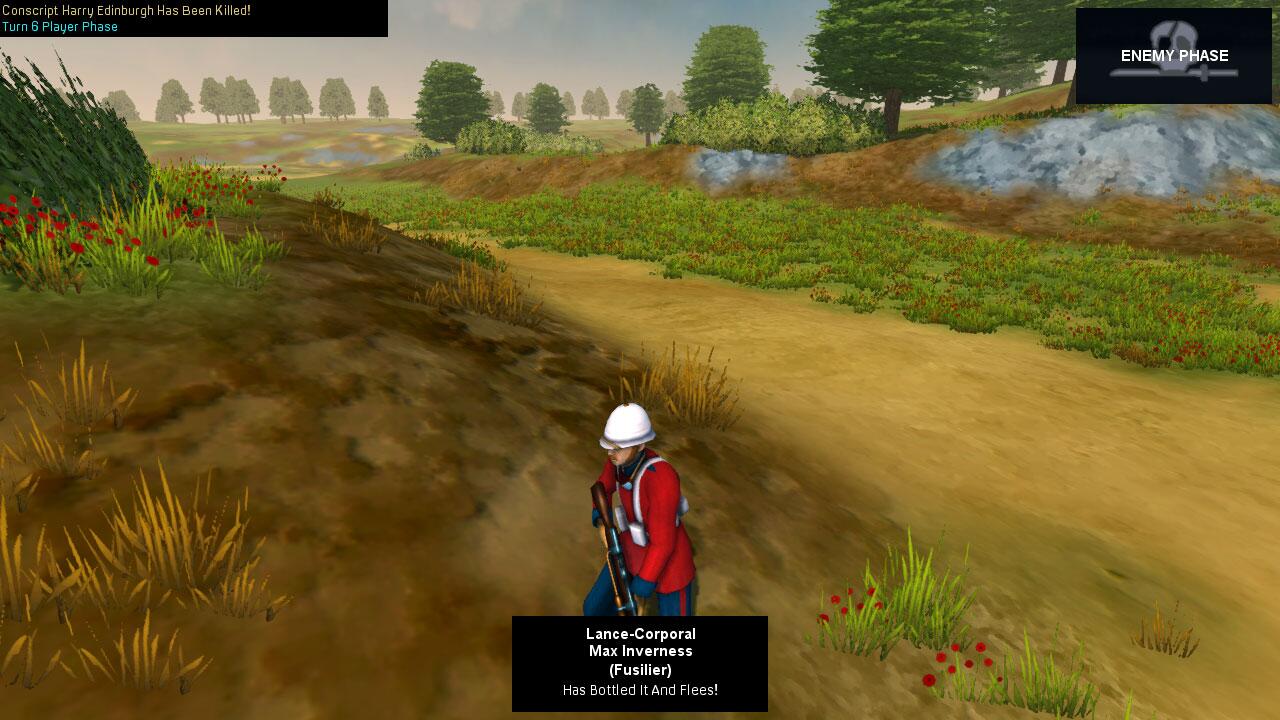
I did love the idea of morale and troops panicking, going beserk and being routed - something which also happens to the enemy - and went as far to call it "Moral Fibre". Troops suffering "shell shock" during the first half of the previous century were said to be "LMF". In game, a sudden loss of comrades can cause all hell to break loose as troops flee from danger or put suppressing fire down on anything they can see - sometimes with astonishing effect as they drop enemies left, right and centre ... sometimes with horror as they mow each other down in the crossfire ...

"Bottling It" (lacking bravery in English slang) has a less clinical feeling than saying routed ...

The Footslogger Not The Armchair General

Strategy and squad tactical games have traditionally had a tendency to viewed from directly above (Steel Panthers) or isometric (X-Com), with the camera freely able to move over the battlefield in a sort of God's Eye View. However I wanted the primary focus of the game to be on the troops themselves.Whilst you do very much play Troopee (Troop Commander) the actions which you order and done via the individual troopers, the camera centred upon them as they move. When they come under fire the bullets whip past them - and also past the camera. It creates an immediacy of presence. Regardless of the player's ambivalence to the individual's life, when they are cut down in a hail of bullets with a scream, fountain of claret and collapse to the ground, it is very much in the player's face, not viewed in some disconnected manner.

In X-Com there was an endless supply of troops with whom the player could upgrade, swap and change for each mission. You could literally have scores of troops sitting around and slowly try to get them all more experienced. I decided to limit the number of core veterans the player could have to just 16. Suddenly losing veterans meant something very immediate. Veterans can only be replaced by Militia survivors (who there is an endless supply of) but there class is predetermined. You can very easily be wanting a sapper or recce to prevent your troops from walking into unseen boobytraps and may have to take the decision to retire one of your better veterans to make room for the new one. Marksmen are also rarer than other classes, intitially much rarer but for the sake of balance I changed that in an update to make a little more available.

Other Stuff That Isn't Getting It's Own Header

I'd liked the day/night cycle and different environments of X-Com and decided on a randomized weather system. I was also tired of playing games where battles were fought at very close ranges. If you take the average FPS, let's say CoD for sake of arguement, firefights with high velocity rifles have a tendancy to take place at 20 feet, and a sniper rifle is doing well to strike a target 100m away. I wanted a clear difference between weapon types, classes, and their ranges. Snipers and Gunny are clearly long range classes, their weapons reflect this, with Fusilier and Recce both being light, close-range classes, and all others being medium. Clipping long range battles at 300 metres gave plenty of scope for tactical movement covered by fire support, whilst preventing both teams firing into each others' spawnpoints/deployment areas.

It was during this point that I gave the troop classes their own ranges for opening fire in the enemy's turn. This provided an extra tactical dimension were Fusilier and Recce could be used to protect the other classes at close range, and vice-versa. In bad weather long ranges classes become less useful, but more useful in clear conditions.

Ammunition was another thing I've noticed disappearing games in the pursuit of casualization. Bullets are heavy things which automatic weapons devour. Take your average real world 7.62mm machine-gun, it can fire 750 rounds a minute, 750 cartridges weigh 25.5kg - that's 55lb. That's what I have on my weights bench ... for a single minute of intense shooting. I wanted bullets - and the troops ability to carry them - to have a strategic value. It's quite easy for a trooper to blaze away at half hidden targets and use up plenty of ammunition in the support role. Which is why you should be navigating an assault team around whatever cover is available whilst the enemy are pinned down.

As an example, I once fought a great battle where my troops and the enemy had met each other on open ground, inflicted casualties on each other before retreating into cover, blazed away at each other from it before both sides rushed forwards into no-man's land to throw grenades at each other whilst looting the dead of their ammunition. It's just how the battle panned out, and it's the sort of example of emergent gameplay which is what I wanted Airship Dragoon to be about.

I've been typing this up all day ... :S

Coming in Part 2: Organic Development And Why No One In Their Right Mind Would Do It!

And as ever ... Greenlight votes very much appreciated! :)


------------------------------------------------

No exact date for writing/publishing part two as I am working on the next update and mod tools. Here's a quick video of mocap animations and camera shake on when fire that will be in the next update.